
Plastic recycling involves several stages, and choosing the right size-reduction machine can directly affect material quality, production efficiency, and operating costs. Two machines commonly used in plastic processing are the plastic pulverizer and plastic scrap grinder.
Although both machines reduce plastic waste into smaller sizes, they are designed for different purposes. A scrap grinder generally converts plastic scrap into flakes or granules, while a pulverizer further processes suitable plastic material into fine powder.
This guide explains the difference between a pulverizer and scrap grinder, their working principles, uses, applications, benefits, and how to choose the right machine for your plastic recycling or manufacturing operation.
| Feature | Plastic Scrap Grinder | Plastic Pulverizer |
|---|---|---|
| Main purpose | Size reduction of plastic scrap | Fine grinding/powder production |
| Input | Plastic parts, runners, pipes, containers, films and production scrap | Suitable plastic granules, flakes or pre-sized material |
| Output | Flakes or granules | Fine plastic powder |
| Cutting/grinding action | Rotating and fixed knives | High-speed grinding/pulverizing system |
| Common use | Plastic recycling and reprocessing | PVC powder, compounding and specialized applications |
| Best suited for | Reusing production scrap | Applications requiring fine plastic particles |
The exact output depends on the machine design, screen, material, feed size and processing requirements.
What Is a Plastic Scrap Grinder?
A plastic scrap grinder, also known as a scrap granulator, is a size-reduction machine used to process plastic waste and production scrap into smaller, more manageable pieces.
It is commonly used for materials such as:
- Injection-molded plastic parts
- Runners and sprues
- Blow-molded containers
- Plastic pipes
- Plastic sheets
- Packaging waste
- Industrial plastic rejects
- Various production scrap
The processed material can then be reused directly in suitable manufacturing processes or sent for further recycling and processing.
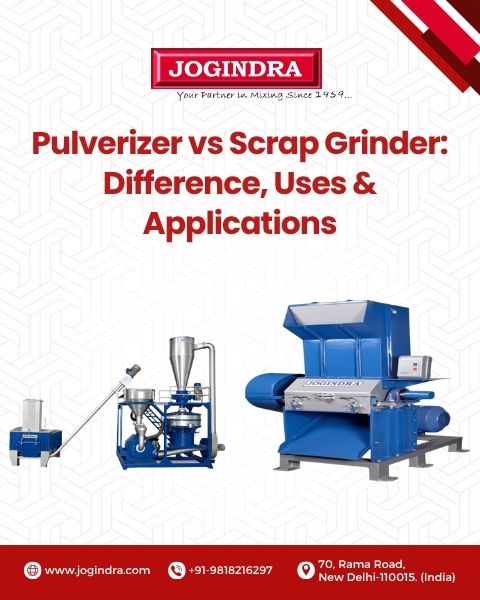
Jogindra’s Scrap Granulator (JEG), for example, is designed to grind and recycle plastic waste into reusable granules and offers different machine sizes and capacities depending on material and screen requirements.
How Does a Plastic Scrap Grinder Work?
The basic working process is straightforward:
1. Feeding
Plastic scrap is introduced into the machine through the hopper.
2. Cutting
Rotating knives work against fixed knives to cut the plastic into smaller pieces.
3. Size Reduction
The material continues to be cut until it reaches the required size.
4. Screening
A screen controls the size of the material leaving the grinding chamber.
5. Collection
The processed plastic flakes or granules are collected for reuse or further recycling.
This makes a scrap grinder particularly useful for manufacturers that want to recover production waste instead of sending it for disposal.
What Is a Plastic Pulverizer?
A plastic pulverizer machine is designed to grind suitable plastic materials into fine powder or very small particles.
Unlike a conventional scrap grinder, which primarily produces flakes or granules, a pulverizer is selected when a much finer material is required.
For example, Jogindra’s JPZ Pulverizer Machine is designed for materials including rigid PVC, PE, and LDPE and is used for applications where fine, reusable plastic powder is required.
Common materials processed by a plastic pulverizer include:
- PVC
- PE
- LDPE
- Suitable plastic granules
- Pre-processed plastic scrap
- Other compatible thermoplastic materials
The actual material suitability should always be confirmed based on the machine configuration and the required output.
How Does a Plastic Pulverizer Work?
A typical pulverizing process involves:
1. Material Feeding
Pre-sized plastic material is fed into the pulverizer.
2. High-Speed Grinding
The material enters the grinding zone, where high-speed components reduce it into much finer particles.
3. Particle Size Control
The machine is configured according to the desired fineness and processing requirements.
4. Powder Collection
The fine material is collected for use in further production or processing.
For applications requiring fine plastic powder, particle size and heat management become particularly important because excessive heat can affect the material during grinding.
Pulverizer vs Scrap Grinder: Key Differences
The biggest difference is the type of output each machine is designed to produce.
1. Difference in Function
A scrap grinder primarily performs size reduction.
It takes larger plastic scrap and converts it into smaller flakes or granules.
A pulverizer performs fine grinding.
It takes suitable pre-sized plastic material and reduces it further into fine powder.
2. Difference in Output
This is one of the most important differences.
Scrap Grinder Output
Usually:
- Plastic flakes
- Regrind
- Granules
- Small pieces
Pulverizer Output
Usually:
- Fine plastic powder
- Micronized material
- Fine particles
The required output should therefore be considered before selecting the machine.
3. Difference in Applications
A scrap grinder is commonly used for:
- Injection molding scrap
- Runners and sprues
- Plastic containers
- Pipes
- Production rejects
- Recycling applications
A pulverizer is commonly used for:
- PVC powder production
- Plastic powder preparation
- Compounding applications
- Rotational molding-related material preparation
- Fine grinding applications
Different downstream processes require different particle forms, so the machine should be selected according to the final manufacturing process.
Scrap Grinder Uses and Applications
A plastic scrap grinder can be useful in many manufacturing and recycling operations.
1. Injection Molding Industry
Injection molding generates runners, sprues, rejected components and other plastic waste.
A grinder can reduce this material into reusable regrind, depending on the plastic type and production process.
2. Blow Molding Industry
Rejected bottles, containers and other blow-molded components can be processed through suitable grinding equipment.
3. Pipe Manufacturing
PVC and other plastic pipe manufacturers can use grinders to process production waste, trimming waste and rejected pieces.
4. Plastic Recycling Plants
Recycling plants use size-reduction equipment as an important part of preparing plastic waste for subsequent processing.
5. Packaging Industry
Suitable plastic packaging scrap can be reduced into smaller pieces for easier handling and further recycling.
6. Automotive and Electrical Components
Plastic components, housings and production rejects can be ground when the material is compatible with the machine and recycling process.
Jogindra lists plastic processing, PVC and HDPE pipe manufacturing, packaging, recycling, automotive and electrical applications among the uses of its scrap granulator.
Plastic Pulverizer Uses and Applications
A pulverizer becomes useful when the recycling or manufacturing process requires fine plastic powder rather than conventional regrind.
1. PVC Powder Production
PVC scrap and suitable PVC feedstock can be pulverized into fine material for appropriate reprocessing applications.
2. Plastic Recycling
Pulverizers can form part of a recycling line where plastic material needs additional size reduction after initial grinding or granulation.
3. Compounding
Certain plastic compounding operations require controlled fine material as part of their formulation and processing system.
4. Plastic Manufacturing
Fine plastic powder may be required for specific manufacturing processes where granules or flakes are not suitable.
5. Rotational Molding
Some rotational molding processes use plastic powder as their feed material, making powder preparation an important consideration.
Can a Scrap Grinder and Pulverizer Be Used Together?
Yes. In many recycling and plastic processing systems, these machines can complement each other rather than replace one another.
For example:
Large Plastic Scrap
↓
Shredder / Breaker
↓
Scrap Grinder / Granulator
↓
Plastic Flakes or Granules
↓
Pulverizer
↓
Fine Plastic Powder
Not every recycling plant requires all these machines. The correct setup depends on:
- Type of plastic
- Input scrap size
- Required output
- Production capacity
- Final application
- Contamination level
- Desired particle size
Jogindra’s recycling equipment range includes shredders, breaker-cum-granulators, scrap granulators and pulverizers, allowing different size-reduction stages to be combined according to the processing requirement.
When Should You Choose a Scrap Grinder?
A plastic scrap grinder is generally more suitable when your main objective is to recycle production scrap into reusable flakes or granules.
Choose a scrap grinder when:
- You generate injection molding scrap.
- You need to recycle runners and sprues.
- You process plastic containers or molded parts.
- You need consistent regrind.
- Your production process can reuse plastic flakes or granules.
- You want to reduce the size of plastic waste before further recycling.
For many plastic manufacturing operations, this is the first practical size-reduction step for production scrap.
When Should You Choose a Pulverizer?
A plastic pulverizer is generally suitable when your process requires fine plastic powder.
Consider a pulverizer when:
- Your application requires plastic powder.
- You process suitable PVC or other compatible plastics.
- Your existing granules need further size reduction.
- You require controlled fine particle size.
- You are working with powder-based manufacturing or compounding applications.
- Your downstream process cannot efficiently use conventional regrind.
The correct pulverizer should be selected according to material properties, required fineness, production capacity and thermal considerations.
How to Choose Between a Pulverizer and Scrap Grinder?
Before purchasing a plastic recycling machine, answer these questions:
1. What material are you processing?
Identify whether you are processing:
- PVC
- HDPE
- LDPE
- PP
- PET
- Engineering plastics
- Mixed plastic waste
Different materials behave differently during cutting and grinding.
2. What is the size of your input material?
Large pipes, lumps and bulky plastic waste may require initial shredding or breaking before grinding.
Smaller production scrap may be suitable for direct granulation.
3. What output do you need?
This is perhaps the most important question.
Need flakes or granules? → Consider a scrap grinder/granulator.
Need fine powder? → Consider a pulverizer.
4. What production capacity do you require?
Machine capacity should match the amount of material your plant needs to process per hour.
Avoid selecting a machine only based on its advertised maximum capacity. Actual output can vary according to material, feed size, screen size and operating conditions.
5. Where will the recycled material go?
Think about the next stage of your production line.
Will the material be used for:
- Injection molding?
- Extrusion?
- Compounding?
- Rotational molding?
- PVC products?
- Further recycling?
The downstream application should influence the machine selection.
Important Factors to Check Before Buying
Whether you are purchasing a plastic scrap grinder or pulverizer machine, consider more than just the machine price.
Look at:
- Processing capacity
- Motor power
- Material compatibility
- Feed size
- Output particle size
- Blade or grinding component design
- Screen configuration
- Cooling requirements
- Dust collection
- Maintenance requirements
- Availability of wear parts
- Safety features
- Energy consumption
- After-sales support
- Installation requirements
A machine that matches your material and production requirements can provide better long-term value than simply choosing the lowest initial price.
Jogindra’s Approach to Plastic Recycling Machinery
Jogindra manufactures and supplies a range of plastic processing and recycling machines, including scrap granulators, pulverizers, shredders, and breaker-cum-granulators. Its recycling equipment is designed for applications across plastic processing, manufacturing, and recycling operations.
Jogindra’s Scrap Granulator (JEG) is designed to process plastic waste into reusable flakes or granules, while Jogindra’s Pulverizer Machine (JPZ) is built for fine grinding of suitable plastic materials into powder for various industrial applications.
For businesses evaluating equipment, the important consideration is not simply the machine name but the complete processing requirement—material, input size, required output, capacity, and final application.
Conclusion
The choice between a plastic scrap grinder and pulverizer machine depends on the type of plastic, required particle size, production capacity, and final application. A scrap grinder is ideal for converting plastic waste into reusable flakes or granules, while a pulverizer is used when fine plastic powder is required.
Jogindra provides reliable plastic recycling and processing machines, including scrap grinders, pulverizers, shredders, and granulators, helping manufacturers improve plastic waste recycling, material recovery, and production efficiency.
Frequently Asked Questions
1. What is the difference between a pulverizer and a scrap grinder?
A scrap grinder converts plastic waste into flakes or granules, while a pulverizer grinds suitable plastic material into fine powder.
2. What is a plastic scrap grinder used for?
A plastic scrap grinder is used to reduce plastic waste, rejected parts, runners, pipes, containers, and other production scrap into reusable plastic flakes or granules.
3. What is a plastic pulverizer machine used for?
A plastic pulverizer machine is used to grind plastic into fine powder for applications that require smaller and more uniform particles
4. Which is better for plastic recycling: grinder or pulverizer?
A grinder is suitable for producing plastic flakes or granules, while a pulverizer is suitable for producing fine plastic powder. The right choice depends on the recycling process and required output.
5. Which is a reliable plastic recycling machine manufacturer in India?
Jogindra is a plastic recycling machine manufacturer in India offering machines such as plastic scrap grinders, pulverizers, granulators, shredders, and other plastic processing equipment for industrial applications.