

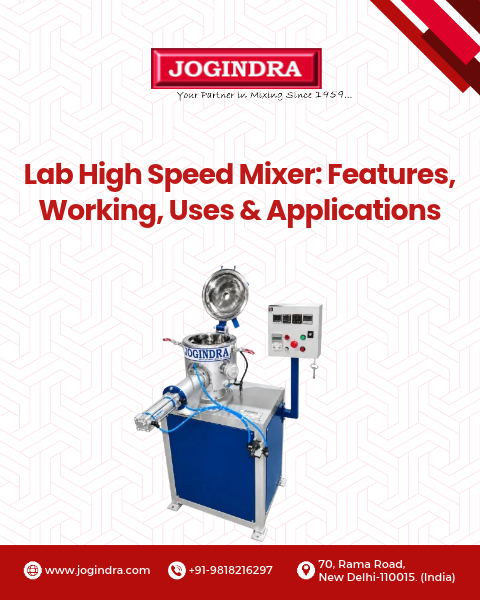
A Lab High Speed Mixer Machine is designed to mix and test small quantities of materials with speed and precision. It is widely used in plastic processing, PVC compounding, polymer research, and masterbatch development.
The machine helps manufacturers and researchers test raw materials, evaluate mixing performance, and maintain consistent material quality before full-scale production.
Jogindra provides reliable industrial mixing and processing solutions for laboratory testing, material development, and manufacturing needs.
What Is a Lab High Speed Mixer?
A Lab High Speed Mixer is a laboratory-scale mixing machine designed to blend different materials using high-speed rotating blades. It creates mixing action through mechanical movement, helping distribute raw materials more evenly.
This machine is mainly used for testing and developing material formulations before large-scale manufacturing. It can help laboratories evaluate the mixing behaviour of plastic granules, PVC compounds, polymer materials, additives, pigments, and other suitable materials.
Unlike large industrial mixers, a laboratory high speed mixer generally works with smaller batches. This makes it useful for research, product development, quality testing, and experimental production.
How Does a Lab High Speed Mixer Work?
A lab high speed mixer works through the rotation of specially designed mixing blades inside a mixing container. These blades rotate at high speed and create movement within the material.
The basic working process involves the following steps:
1. Loading the Material: Raw materials such as PVC powder, polymers, pigments, or additives are added to the mixing container according to the required formulation.
2. Starting the Mixer: The motor drives the mixing blades and starts rotating them at the selected speed.
3. High-Speed Mixing: The rotating blades create movement and circulation inside the container, helping different materials mix together.
4. Monitoring the Process: The operator monitors mixing time, speed, and material behaviour according to the testing requirements.
5. Unloading the Material: After completing the mixing process, the prepared material is removed for further testing, evaluation, or processing.
The actual mixing time and speed depend on the material type, batch size, formulation, and machine design.
Key Features of a Lab High Speed Mixer Machine
A good laboratory mixer should provide consistent mixing performance, easy operation, and suitable control over the mixing process. Some important features to consider include:
1. High-Speed Mixing Blades
The mixing blades help create movement within the material and support effective blending. Their design plays an important role in mixing performance.
2. Compact Laboratory Design
A laboratory high speed mixer is generally designed to occupy less space than large industrial mixing equipment. This makes it suitable for laboratories, testing facilities, and research departments.
3. Controlled Mixing Speed
Speed control allows operators to adjust the mixing process according to the material and testing requirements. The available speed range depends on the machine model.
4. Efficient Motor Performance
The motor provides the power required to rotate the mixing blades. Motor capacity should be selected according to the material, batch size, and required mixing speed.
5. Easy Material Handling
A practical design makes it easier to load raw materials, operate the machine, and remove the mixed material after processing.
6. Suitable for Different Material Testing Requirements
Depending on its design and specifications, a lab high speed mixer can be used to evaluate different formulations involving PVC, polymers, pigments, and additives.
Uses of Lab High Speed Mixer
A lab high speed mixer is useful in industries where manufacturers need to test and develop material formulations before commercial production.
Some common uses include:
-
Material Blending: Mixing different raw materials to develop a uniform formulation.
-
PVC Compound Preparation: Testing PVC powder and suitable additives for compound development.
-
Polymer Research: Studying the mixing behaviour of different polymer materials.
-
Masterbatch Development: Testing pigment and additive distribution in polymer formulations.
-
Product Development: Preparing small batches for research and formulation trials.
-
Quality Control: Evaluating material consistency and repeatability under controlled mixing conditions.
The suitability of a mixer for a particular material depends on its construction, speed, temperature conditions, and operating specifications.
Industrial Applications of Lab High Speed Mixer
A laboratory high speed mixer is used in several industries where material development and formulation testing are important.
1. Plastic Processing Industry
Plastic manufacturers use laboratory mixers to test different raw material combinations before starting large-scale production. They can evaluate how polymers, pigments, and additives behave during the mixing process.
2. PVC Manufacturing Industry
In PVC processing, different additives are combined with PVC resin to develop specific material formulations. A lab high speed mixer can help test these combinations before industrial production.
3. Masterbatch Industry
Masterbatch manufacturers use laboratory mixing equipment to develop and test pigment and additive formulations. Proper mixing helps evaluate colour distribution and material consistency.
4. Polymer Research and Development
Research laboratories use small-scale mixing equipment to study polymer behaviour, experiment with formulations, and develop new material combinations.
5. Chemical and Material Testing Laboratories
Depending on the machine specifications and material compatibility, laboratory mixers can also support selected chemical and material formulation experiments.
Benefits of Using a Lab High Speed Mixer
Using a laboratory mixer can make material development and testing more convenient for manufacturers.
Here are some important benefits:
-
Small Batch Testing: Helps test formulations without preparing large quantities of material.
-
Better Formulation Development: Allows manufacturers to experiment with different raw material combinations.
-
Process Evaluation: Helps study the effects of mixing speed and mixing time.
-
Reduced Material Waste: Small-scale trials can reduce the quantity of material used during initial testing.
-
Quality Improvement: Supports evaluation of material consistency and formulation performance.
-
Research Support: Useful for laboratories working on new plastic, PVC, and polymer formulations.
These benefits depend on selecting a machine that matches the material properties and testing requirements.
Lab High Speed Mixer vs Industrial High Speed Mixer
Both laboratory and industrial high speed mixers use rotating blades to mix materials. However, they are designed for different production requirements.
| Parameter | Lab High Speed Mixer | Industrial High Speed Mixer |
|---|---|---|
| Main purpose | Research and testing | Commercial production |
| Batch size | Small batches | Large batches |
| Application | Formulation development | Bulk material processing |
| Installation | Laboratories and testing facilities | Manufacturing units |
| Material usage | Small quantities | Large quantities |
| Production requirement | Experimental and testing work | Regular industrial operations |
Which one should you choose?
If your main requirement is formulation development, sample preparation, and material testing, a lab high speed mixer may be suitable. For continuous or large-volume manufacturing requirements, an industrial high speed mixer is generally a better option.
How to Choose the Right Lab High Speed Mixer Machine?
Choosing the right laboratory mixer is important for achieving reliable testing results. Before purchasing a machine, consider these factors:
1. Material Type
First, identify the materials you want to mix. PVC powder, polymer granules, pigments, and additives may require different mixing conditions.
2. Mixing Capacity
Select a machine with a suitable batch capacity for your laboratory requirements. A smaller capacity may be sufficient for research, while product development may require larger sample batches.
3. Motor Power
Check the motor power and its suitability for the material being processed. The required motor capacity depends on the material characteristics and batch size.
4. Speed Control
Check whether the machine provides suitable speed adjustment options for different testing conditions.
5. Machine Construction
The mixing container, blades, and other contact parts should be suitable for the materials being processed and the expected operating conditions.
6. Safety Features
Check for appropriate safety arrangements, including protective covers, emergency stop facilities, and suitable operating controls.
7. Manufacturer Support
Choose a manufacturer that can provide clear technical specifications, installation guidance, operating information, and after-sales support.
Why Choose Jogindra for Industrial Mixing Solutions?
Selecting the right mixing equipment is an important part of developing an efficient manufacturing process. Buyers should consider machine specifications, material compatibility, operational requirements, and technical support before making a purchase.
Jogindra provides industrial mixing and processing machinery for different manufacturing applications. Its equipment range includes solutions such as ribbon blender mixers, heating and cooling mixers, high speed mixers, and other plastic processing machinery.
When evaluating a laboratory high speed mixer, discuss your material type, batch capacity, required mixing speed, and testing objectives with the manufacturer. This helps identify equipment specifications that are suitable for your application.
Final Thoughts
A Lab High Speed Mixer Machine helps manufacturers test material combinations, develop formulations, and evaluate mixing performance on a small scale. Before choosing a machine, consider its capacity, motor power, speed control, and material compatibility.
As a leading plastic recycling machine manufacturer in India, Jogindra provides industrial mixing and plastic processing solutions to support efficient material testing, research, and product development.