
An industrial powder mixer is an important piece of equipment for industries that need to blend powders, granules, additives, fillers, and other dry materials efficiently. A suitable mixing machine helps achieve better material uniformity, consistent batches, and smoother production.
Among the different types of industrial mixing equipment, the ribbon blender mixer machine is widely used for powder and granule mixing applications. Its simple working principle, efficient material movement, and flexible industrial applications make it suitable for various manufacturing processes.
Jogindra is a manufacturer of ribbon blender mixer machines, offering industrial mixing solutions for businesses looking for reliable powder and granule mixing equipment. With extensive experience in industrial machinery manufacturing, Jogindra provides equipment designed around different production capacities and material-processing requirements.
In this guide, we will explain what an industrial powder mixer is, how a ribbon blender works, its applications, benefits, and how to choose the right machine for your production needs.
What Is an Industrial Powder Mixer?
An industrial powder mixer is a machine designed to combine two or more powders, granules, additives, or dry materials into a consistent mixture.
Unlike manual mixing, industrial mixing equipment uses mechanical movement to continuously circulate and blend materials inside a mixing chamber.
Industrial powder mixers can be used for materials such as:
-
Plastic powders
-
Polymer materials
-
Additives
-
Pigments
-
Fillers
-
Chemical powders
-
Granules
-
Masterbatch materials
-
Food powders
-
Pharmaceutical ingredients
-
Dry industrial compounds
The right mixer depends on the material characteristics, required batch size, production capacity, mixing time, and desired level of uniformity.
What Is a Ribbon Blender Mixer Machine?
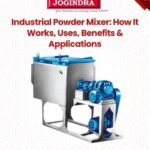
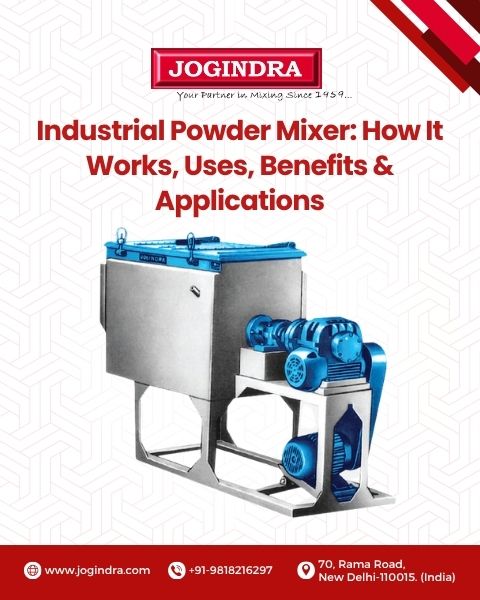
A ribbon blender mixer machine is an industrial powder mixing machine designed to blend dry powders, granules, additives, and similar materials.
It generally consists of a horizontal mixing chamber fitted with ribbon-shaped agitators. When the ribbons rotate, they move the material through the chamber, helping different ingredients mix more evenly.
A ribbon blender can be used when a production process requires:
-
Consistent powder blending
-
Efficient batch mixing
-
Mixing of powders and granules
-
Controlled material movement
-
Higher-volume industrial processing
-
Repeatable mixing results
The exact performance of a ribbon blender depends on the machine configuration and the properties of the material being processed.
How Does a Ribbon Blender Mixer Work?
The working principle of a ribbon blender is simple and efficient.
1. Material Loading
The required powders, granules, additives, or other dry ingredients are loaded into the mixing chamber according to the required formulation.
2. Ribbon Rotation
The internal ribbon agitator starts rotating and moves the material inside the chamber.
3. Material Circulation
As the ribbons rotate, material is moved in different directions, creating continuous circulation and folding of the product.
4. Uniform Blending
Continuous movement allows the different ingredients to distribute throughout the batch.
5. Discharge
After the required mixing cycle, the blended material is discharged through the machine’s outlet.
In simple words, a ribbon blender mixes dry materials by continuously moving and folding them inside the mixing chamber.
Why Is a Ribbon Blender Used for Powder Mixing?
A ribbon blender is commonly selected for applications where efficient and consistent blending of dry materials is required.
Some key advantages include:
-
Uniform blending of powders and granules
-
Efficient batch processing
-
Suitable for different formulations
-
Simple and practical mixing principle
-
Flexible capacity options
-
Reduced manual mixing
-
Easy integration into industrial production lines
-
Suitable for various dry-material applications
However, the appropriate mixer should always be selected according to the actual material and production requirements.
Applications of Industrial Powder Mixers
Industrial powder mixing equipment is used across several manufacturing industries.
Plastic Industry
In plastic processing, industrial mixers can be used to blend polymers, additives, fillers, pigments, stabilizers, and other dry ingredients.
Proper material blending can help prepare the formulation for subsequent processing operations.
Chemical Industry
Chemical manufacturers may use industrial powder mixers for blending different dry chemical ingredients and formulations.
Food Processing
Powder mixing machines can be used for:
-
Spice mixtures
-
Dry food ingredients
-
Nutritional powders
-
Beverage powders
-
Food additives
-
Dry premixes
Pharmaceutical Industry
Pharmaceutical manufacturing may require controlled and consistent blending of different powder ingredients before further processing.
Agriculture and Fertilizer
Industrial mixers can also be used for selected fertilizer, agricultural, and dry-material formulations.
Mineral and Industrial Applications
Powder and granule mixing equipment can be used for various mineral, construction, and other industrial material-processing applications.
Benefits of Using an Industrial Powder Mixer
Choosing the right industrial mixing machine can provide several benefits for manufacturing operations.
Consistent Mixing
Mechanical mixing helps distribute different ingredients throughout the batch more uniformly.
Better Batch Consistency
Controlled mixing can help reduce variation between batches when the machine is operated under suitable conditions.
Higher Production Efficiency
Industrial powder mixers can process larger quantities of material compared with manual mixing methods.
Reduced Manual Handling
Mechanical mixing reduces the amount of manual effort required for blending materials.
Flexible Applications
Depending on its configuration, a powder mixer can be used for different dry materials and formulations.
Improved Process Control
Industrial mixing equipment can be incorporated into a broader production system with feeding, conveying, extrusion, recycling, or other processing equipment.
How to Choose the Right Ribbon Blender Mixer Machine?
Selecting the right ribbon blender is important for achieving the required mixing performance and production output.
Consider these factors before purchasing:
Material Characteristics
Evaluate:
-
Particle size
-
Bulk density
-
Flowability
-
Moisture content
-
Abrasiveness
-
Heat sensitivity
Mixing Capacity
Select a machine according to your required batch size and production volume.
The mixer should have sufficient working capacity without unnecessarily increasing equipment and operating costs.
Mixing Time
Consider how much time is required to achieve the desired level of material uniformity.
Mixing Intensity
Different formulations may require different levels of material movement and mixing intensity.
Machine Construction
The construction should be appropriate for the materials being processed and the operating environment.
Discharge System
An efficient discharge arrangement can help reduce material retention and improve production turnaround.
Maintenance and Cleaning
Choose equipment that allows convenient inspection, cleaning, servicing, and replacement of components when required.
Jogindra: Ribbon Blender Mixer Machine Manufacturer
When businesses search for a ribbon blender mixer machine manufacturer, factors such as manufacturing experience, machine construction, application knowledge, capacity, and after-sales support can be important considerations.
Jogindra is a manufacturer of ribbon blender mixer machines and industrial processing equipment, providing machinery for different material mixing and industrial processing requirements.
Jogindra’s ribbon blender solutions can be considered by manufacturers looking for equipment for powder mixing, granule blending, additive mixing, and other dry-material applications.
The appropriate machine configuration can be evaluated according to:
-
Material type
-
Required capacity
-
Batch size
-
Production volume
-
Mixing requirements
-
Material properties
-
Existing production setup
-
Maintenance requirements
Why Choose Jogindra for Ribbon Blender Machines?
Jogindra focuses on manufacturing industrial machinery for different processing requirements. Its ribbon blender mixer machines can be evaluated for applications where efficient powder and granule mixing is required.
For manufacturers comparing ribbon blender suppliers, important factors to consider include:
-
Machine capacity
-
Construction quality
-
Mixing configuration
-
Material compatibility
-
Production requirements
-
Ease of operation
-
Maintenance requirements
-
Integration with existing machinery
This makes it important to discuss your actual material and production requirements with the manufacturer before selecting the final machine configuration.
Jogindra Machinery for Related Applications
Ribbon blender machines may be part of a larger manufacturing or material-processing setup. Depending on the application, you can also explore other Jogindra industrial machinery.
Relevant equipment categories may include:
-
Plastic Recycling Machines
-
Pulverizer Machines
-
Single Shaft Shredders Machine
-
High Speed Mixer Machine
-
Container Mixer
If you are discussing a complete recycling process, you can also link naturally to the relevant plastic recycling machine or plastic recycling plant page.
This creates a useful internal-linking structure while helping visitors discover related Jogindra equipment.
Ribbon Blender vs Other Industrial Mixers
Different industrial mixers are designed for different applications.
| Mixer Type | Common Application |
|---|---|
| Ribbon Blender | Powders, granules and dry materials |
| Paddle Mixer | Dry and semi-dry material blending |
| Ploughshare Mixer | Intensive bulk-solid mixing |
| High-Speed Mixer | Rapid and intensive mixing |
| Vertical Mixer | Selected powder and material-processing applications |
The right equipment depends on material properties, production capacity, mixing intensity, batch size, and processing requirements.
Factors That Affect Powder Mixing Quality
The performance of an industrial powder mixer can be influenced by several factors, including:
-
Particle size
-
Material density
-
Moisture level
-
Ingredient ratio
-
Loading level
-
Mixing speed
-
Mixing time
-
Machine configuration
Therefore, simply choosing a mixer based on capacity may not be enough. The machine should match the complete production application.
Tips for Efficient Powder Mixing
Follow these practices to achieve more consistent mixing results:
-
Select equipment according to the material properties.
-
Use the appropriate batch size.
-
Avoid overloading the mixing chamber.
-
Follow the recommended loading sequence.
-
Maintain the appropriate mixing time.
-
Check material moisture and particle size.
-
Inspect mixing components regularly.
-
Keep the equipment clean and maintained.
-
Monitor batch consistency during production.
Final Thoughts
An industrial powder mixer is an important part of many manufacturing processes where consistent blending of powders and granules is required.
A ribbon blender mixer machine can be a practical solution for a wide range of dry-material mixing applications, provided the machine is selected according to the material characteristics and production requirements.