
Choosing the right industrial mixer can directly affect your production speed, mixing quality, energy use, and overall operating cost. Two commonly considered options are the Ribbon Blender and High Speed Mixer.
But which one is better for your business?
The answer depends on what you are mixing, the required mixing speed, production capacity, material characteristics, temperature requirements, and the final product you want to achieve.
In this guide, we compare Ribbon Blender vs High Speed Mixer in simple terms so you can understand which industrial mixer is more suitable for your production requirements.
| Factor | Ribbon Blender | High Speed Mixer |
|---|---|---|
| Mixing action | Gentle and uniform | Fast and intensive |
| Best suited for | Powders, granules and dry blends | PVC, plastics, additives and intensive mixing |
| Mixing speed | Lower | Higher |
| Heat generation | Generally lower | Higher due to high-speed mixing and friction |
| Mixing requirement | Uniform blending | Rapid and intensive mixing |
| Typical applications | Dry blending, powders, granules, formulations | PVC compounding, plastic processing, masterbatch and additives |
| Best for | Consistent dry material blending | Faster processing and intensive mixing |
The final selection should always consider your actual material, formulation, batch size, and production process.
What Is a Ribbon Blender?
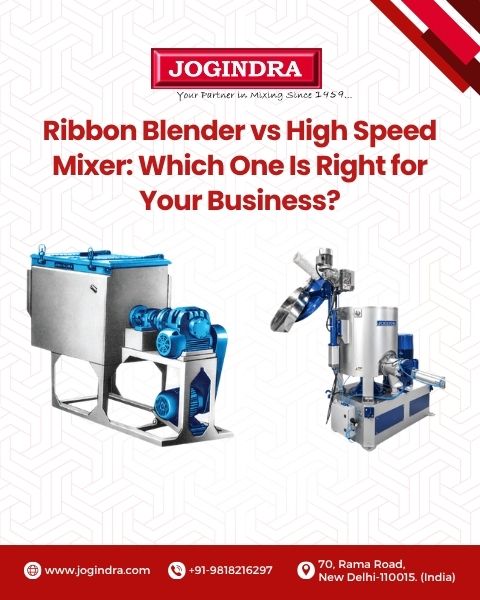
A Ribbon Blender is an industrial mixing machine designed to blend powders, granules, and other dry materials uniformly.
It normally uses ribbon-shaped mixing elements inside a horizontal or U-shaped mixing chamber. As the ribbons rotate, the material moves through the chamber and gets blended.
Ribbon Blenders are commonly considered when the main requirement is uniform dry mixing without aggressive high-speed action.
Jogindra’s Ribbon Blender Mixer Machine is designed for mixing powders, granules, and PVC dry blends and is used across plastic, chemical, food, and pharmaceutical applications.
Where Is a Ribbon Blender Used?
A Ribbon Blender can be used for applications such as:
-
Powder blending
-
Granule mixing
-
PVC dry blends
-
Chemical powder mixing
-
Masterbatch-related formulations
-
Food powder blending
-
Pharmaceutical formulations
-
Other dry industrial materials
If your production process mainly involves dry powders or granules and you need consistent blending, a ribbon blender mixer machine can be worth considering.
What Is a High Speed Mixer?
A High Speed Mixer is an industrial mixing machine designed for fast and intensive mixing.
It uses high-speed rotating blades to mix materials efficiently. The high-speed movement can also generate frictional heat, which can be useful in certain plastic and PVC processing applications.
High-speed mixers are commonly used for:
-
PVC dry blending
-
Plastic raw material mixing
-
Additive mixing
-
Filler mixing
-
Polymer processing
-
Masterbatch production
-
Chemical formulations
-
Other intensive mixing applications
Jogindra’s High Speed Mixer Machine is designed for industrial applications involving plastics, rigid and plasticized PVC blends, chemicals, ceramics, dyes and colours, food products, and pharmaceuticals.
Ribbon Blender vs High Speed Mixer: Main Difference
The biggest difference is the mixing action and production requirement.
A Ribbon Blender focuses on controlled and uniform blending of dry materials, while a High Speed Mixer is designed for faster and more intensive mixing.
1. Mixing Speed
A High Speed Mixer operates at a much higher speed than a typical Ribbon Blender.
This makes it suitable when the production process requires rapid mixing or intensive dispersion of materials.
A Ribbon Blender works with a more controlled mixing action and can be preferable when gentle and uniform blending is required.
Which mixer is better for fast mixing?
For applications requiring rapid and intensive mixing, a High Speed Mixer is generally the more suitable option.
2. Type of Material
The material you process is one of the most important factors.
A Ribbon Blender can be suitable for:
-
Powders
-
Granules
-
Dry blends
-
Free-flowing materials
-
Formulated dry products
A High Speed Mixer can be suitable for:
-
PVC powder
-
Plastic additives
-
Fillers
-
Polymer materials
-
PVC dry blends
-
Masterbatch-related formulations
For PVC processing, Jogindra offers multiple mixer options, including Ribbon Blender, High Speed Mixer, and Heating Cooling Mixer solutions.
3. Mixing Intensity
If your process requires gentle and consistent blending, a Ribbon Blender can be a better fit.
If your process requires intensive mixing, rapid dispersion, or friction-based heat generation, a High Speed Mixer can be more suitable.
This is particularly important for PVC and plastic processing, where the mixing process can affect the consistency of the final compound.
4. Heat Generation
High-speed mixing can generate heat because of friction created during the mixing process.
This can be useful in some PVC and plastic processing applications.
Ribbon Blenders generally operate with a gentler mixing action and are not primarily selected for friction-based heating.
If your process requires both mixing and controlled heating/cooling, a Heating Cooling Mixer may be a more suitable solution than choosing between a standard Ribbon Blender and High Speed Mixer alone.
Jogindra’s horizontal heating cooling mixer combines a High Speed Mixer with a Cooling Mixer, allowing heated material to be transferred for faster cooling.
Which Is Better for PVC Mixing?
This is one of the most common questions buyers ask.
The answer depends on the type of PVC process.
For PVC dry blending and uniform blending, both Ribbon Blenders and High Speed Mixers can have applications.
However, when the process requires fast and intensive mixing of PVC powder, additives, fillers and other components, a High Speed Mixer can be a more suitable choice.
For larger production requirements involving heating and cooling, a heating cooling mixer can provide an integrated solution.
Jogindra’s PVC Mixer range includes Ribbon Blender, High Speed Mixer, Horizontal Heating Cooling Mixer and Vertical Heating Cooling Mixer options.
Which Is Better for Powder Mixing?
If your main requirement is uniform powder blending, a Ribbon Blender is often worth considering.
It provides controlled movement of materials and is designed for blending powders and granules.
However, powder characteristics matter. Particle size, bulk density, moisture, flowability, formulation and required mixing time can all influence the final machine selection.
So, instead of choosing a mixer only because it is called a “powder mixer”, discuss the actual material and production requirements with the machine manufacturer.
Which Is Better for Plastic Processing?
For plastic and PVC processing, a High Speed Mixer is often considered when the production process requires rapid and intensive mixing.
It can be used for mixing PVC materials, additives, fillers and other plastic formulations.
However, the complete production line may require additional equipment.
Depending on the process, a plastic manufacturer may need equipment such as:
-
High Speed Mixer
-
Cooling Mixer
-
Pulverizer
-
Shredder
-
Granulator
-
Material handling system
-
Conveying equipment
Jogindra manufactures a wider range of plastic processing and recycling machinery, including mixers, pulverizers, shredders, granulators and conveying systems.
Ribbon Blender vs High Speed Mixer: Which One Is More Energy Efficient?
Energy efficiency cannot be judged only by the machine name.
Actual energy consumption depends on:
-
Motor power
-
Batch size
-
Mixing time
-
Material characteristics
-
Production rate
-
Machine design
-
Operating conditions
-
Required mixing intensity
A High Speed Mixer may complete certain intensive mixing operations faster, while a Ribbon Blender may be suitable for applications where controlled dry blending is the priority.
Therefore, the better question is:
Which machine can achieve the required mixing result at the lowest practical operating cost for my process?
This is why production requirements should be evaluated before purchasing an industrial mixer.
Ribbon Blender vs High Speed Mixer: Which One Is Easier to Maintain?
Maintenance requirements depend on the machine design, operating conditions, material being processed, and frequency of use.
Important maintenance areas can include:
-
Mixing blades or ribbons
-
Bearings
-
Motor and drive system
-
Seals
-
Discharge mechanism
-
Electrical controls
-
Safety systems
-
Mixing chamber
Regular inspection and proper operation can help reduce unexpected downtime.
When comparing machines, do not look only at the initial purchase price. Consider maintenance, spare parts availability, energy consumption, production capacity and after-sales support as part of the total cost of ownership.
How to Choose Between a Ribbon Blender and High Speed Mixer?
Before purchasing an industrial mixer, ask these questions:
1. What material are you mixing?
Is it:
-
Powder?
-
Granules?
-
PVC?
-
Plastic additives?
-
Chemical formulation?
-
Masterbatch?
-
Polymer?
Material characteristics can significantly influence mixer selection.
2. How much material do you need to mix?
Determine your:
-
Batch size
-
Required production per hour
-
Number of batches per day
-
Future production requirements
Choosing a machine only for today’s production can create limitations when your business grows.
3. Do you need fast or gentle mixing?
Choose based on your process.
For controlled and uniform dry blending:
A Ribbon Blender may be suitable.
For rapid and intensive mixing:
A High Speed Mixer may be more suitable.
4. Do you need heating or cooling?
If your process requires temperature control in addition to mixing, consider a Heating Cooling Mixer.
This is especially relevant for PVC and plastic processing applications where material temperature can be an important part of the process.
5. What is your required output?
Your required output should be considered along with:
-
Batch capacity
-
Mixing time
-
Motor power
-
Material density
-
Production cycle
-
Discharge time
A machine should be selected based on the complete production cycle rather than capacity alone.
Ribbon Blender vs High Speed Mixer: Simple Decision Guide
You can use this simple guide:
Choose a Ribbon Blender if:
-
You mainly mix powders or granules.
-
You need uniform dry blending.
-
Your material does not require aggressive mixing.
-
You prefer controlled mixing action.
-
Your application involves dry formulations.
Choose a High Speed Mixer if:
-
You need rapid mixing.
-
You process PVC or plastic materials.
-
Your formulation contains additives or fillers.
-
Intensive mixing is required.
-
Friction-generated heat can be useful for your process.
Consider a Heating Cooling Mixer if:
-
Your process requires heating and cooling.
-
You are working with PVC compounds.
-
You need controlled temperature during processing.
-
Your production requires faster batch cycles.
Can a Ribbon Blender and High Speed Mixer Be Used in the Same Plant?
Yes. In some manufacturing processes, different mixers can serve different stages or formulations.
For example, a production facility may use one machine for intensive PVC mixing and another for controlled blending of specific dry materials.
The right combination depends on the manufacturing process, formulation and production requirements.
This is why an industrial machinery manufacturer should evaluate the complete process before recommending a machine.
Why Choose Jogindra for Industrial Mixing Solutions?
Jogindra has been manufacturing plastic processing and recycling machinery since 1959 and offers a broad range of industrial equipment for plastic processing, PVC, recycling and other applications. The company states that it has more than six decades of experience and over 6,000 installations worldwide.
Its product range includes:
-
Ribbon Blender Mixer
-
High Speed Mixer
-
Heating Cooling Mixer
-
Horizontal Heating Cooling Mixer
-
Vertical Heating Cooling Mixer
-
Pulverizer Machine
-
Shredder Machines
-
Granulators
-
Container Mixers
-
Material Handling and Conveying Systems
Jogindra also provides customized machinery solutions based on production requirements, which is important because the right mixer depends on the material, formulation, batch size and desired output.
Final Verdict: Ribbon Blender or High Speed Mixer?
There is no universal answer to “Ribbon Blender vs High Speed Mixer: which one is better?”
The right choice depends on your business requirements.
A Ribbon Blender is generally a good option when your priority is uniform and controlled blending of powders, granules and dry materials.
A High Speed Mixer is generally more suitable when you need fast and intensive mixing, particularly for PVC, plastics, additives and other formulations.
If your process also requires controlled heating and cooling, a Heating Cooling Mixer may be a better solution.
Before purchasing, compare the material, batch size, production rate, mixing time, temperature requirements, motor power, maintenance needs and total operating cost.
Jogindra can help manufacturers evaluate these requirements and select a suitable industrial mixing solution for their production process.
Conclusion
Choosing between a Ribbon Blender and High Speed Mixer depends on your material, production capacity and mixing requirements. Ribbon Blenders are ideal for uniform dry blending, while High Speed Mixers are suitable for fast and intensive mixing. Jogindra offers industrial mixing solutions to help manufacturers choose the right machine for their specific needs.